
McKinsey’s latest data center capex analysis points to a clear reality: speed, standardization, procurement discipline, and off-site delivery are becoming core levers for capital efficiency.
For CEOs, CFOs, infrastructure developers, and capital teams, the question is direct: How efficiently can we turn capital into capacity?
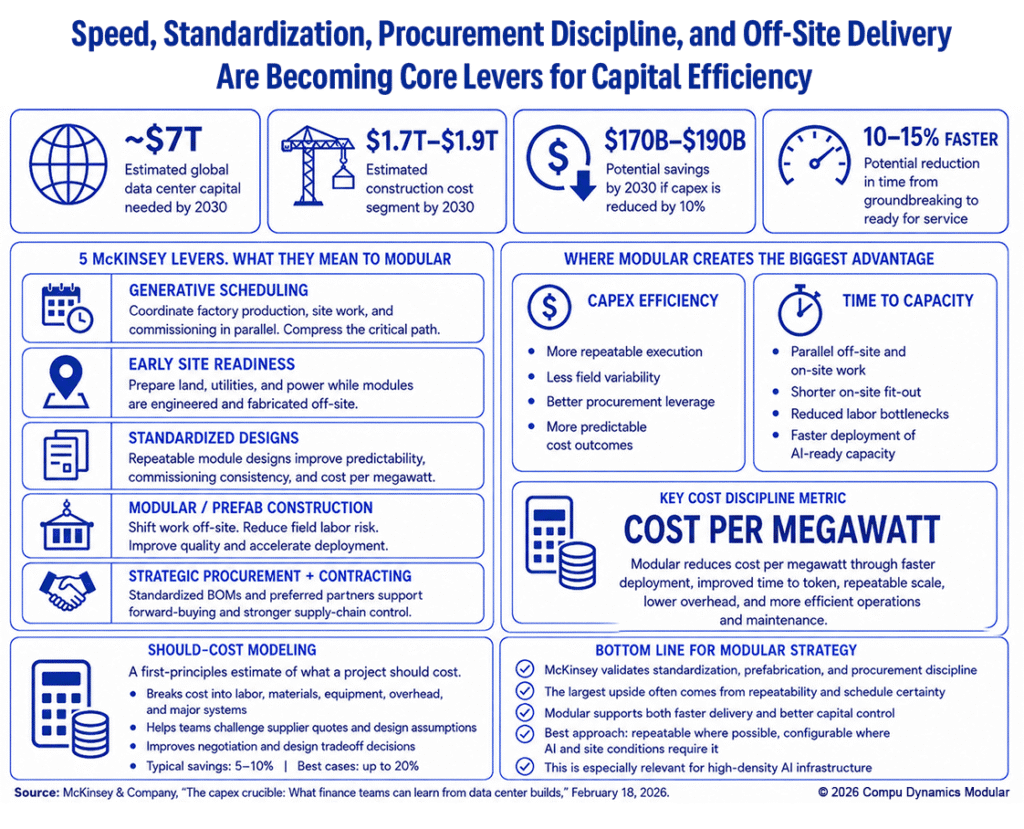
The scale of the challenge is massive. Global data centers are expected to require roughly $7 trillion in capital by 2030, including $1.7 trillion to $1.9 trillion in construction costs. Reducing data center capex by just 10 percent could represent roughly $170 billion to $190 billion in potential savings by 2030. Faster delivery could also reduce the time from groundbreaking to ready for service by 10 to 15 percent.
At that scale, improvements in cost, schedule, procurement, and execution certainty aren’t small project efficiencies. They are strategic capital levers.
Modular Turns Capex Discipline Into a Delivery Model
The data center industry is under pressure from every direction: power availability, equipment lead times, site constraints, labor risk, higher densities, liquid cooling, and the relentless pace of AI workload demand.
Traditional data centers remain essential for large-footprint colocation and cloud environments. But when the objective is to deploy repeatable AI capacity faster, with greater cost certainty and schedule control, modular becomes a serious capital strategy.
Factory production, site preparation, utility work, and commissioning can move in parallel. Land, power, fiber, permitting, and civil work can advance while modules are engineered and manufactured off-site.
That matters because the critical path changes. More work happens in a controlled environment, meaning less work depends on unpredictable field conditions. Quality becomes easier to manage. Labor exposure becomes easier to control. Procurement becomes easier to plan.
The result isn’t just faster construction. It is a more repeatable and financially disciplined way to deliver capacity.
Cost Per Megawatt Is the Metric That Matters
For capital teams, the conversation shouldn’t stop at AI infrastructure deployment speed. The stronger argument is cost per megawatt and how modular compares against other build options when speed, scale, overhead, field labor, procurement, operations, and maintenance are all factored in.
Modular data centers can reduce cost per megawatt through faster deployment, repeatable scale, lower overhead, reduced field labor exposure, more predictable procurement, and more efficient operations and maintenance.
This becomes even more important in AI infrastructure. High-density environments require tight coordination between power, cooling, IT, controls, networking, security, serviceability, and long-term operations. Delays or redesigns don’t just create construction issues. They delay business value.
For AI workloads, faster capacity also means better time to token. The sooner high-density infrastructure is online, the sooner teams can support training, inference, and production workloads.
Standardization Is the Financial Advantage
One of modular’s biggest strengths is repeatability. Repeatable designs make budgets easier to validate. Repeatable bills of material improve procurement leverage. Repeatable manufacturing and commissioning processes reduce variation. Repeatable operating models make maintenance and lifecycle support more predictable. That is exactly what capital teams need when they are trying to deploy infrastructure at scale.
But repeatable doesn’t mean rigid. AI workloads are too varied for a one-size-fits-all approach. Training clusters, inference nodes, enterprise AI environments, industrial deployments, and edge sites can all have different requirements for power density, cooling architecture, network connectivity, security, site conditions, and serviceability. The right modular strategy is simple: Repeatable where speed and consistency matter. Configurable where the workload and site demand it. That is where modular data centers fit best.
Modular Is a Capex Strategy
As data center investment continues to accelerate, capital discipline will become even more important. For data center owner operators, hyperscalers, neoclouds, and enterprises, the opportunity is to look beyond traditional delivery models and consider approaches that can improve speed, predictability, procurement control, and cost performance while turning infrastructure plans into usable capacity with greater confidence.
If your team is exploring modular data center strategies, the CDM team would be glad to talk through what’s possible with a turnkey modular data center solution.
