The 5G era promised lightning-fast speeds, ultra-low latency, and seamless device connectivity. Yet, for many telecom operators, realizing that potential remains difficult. Network densification, spectrum costs, limited edge compute capacity, and rising energy consumption continue to strain budgets and slow deployments.
At the same time, data traffic continues to explode driven by AI, IoT, and connected devices—requiring more localized processing and intelligent infrastructure. McKinsey & Company predicts that global data center demand could rise as high as 298 gigawatts by 2030, from just 55 gigawatts in 2023. Fiber connections to AI-infused data centers could generate up to $50 billion globally in sales to fiber facilities-based carriers.
The Leap from 5G to 6G
While 5G continues to mature, 6G is already on the horizon. Expected in North America by the late 2020s, 6G will move beyond enhanced mobile broadband toward AI-native, cloud-integrated networks optimized for real-time performance. This leap will enable ultra-low latency applications such as 8K video streaming, cloud gaming, holographic communication, and connected intelligence across industries. Early initiatives, such as Verizon’s 6G Innovation Forum, in collaboration with Meta, signal the rapid pace of development, with pilot deployments anticipated as early as 2027.
To power both the ongoing 5G buildout and the transition to 6G, AI-driven modular data centers will be essential.
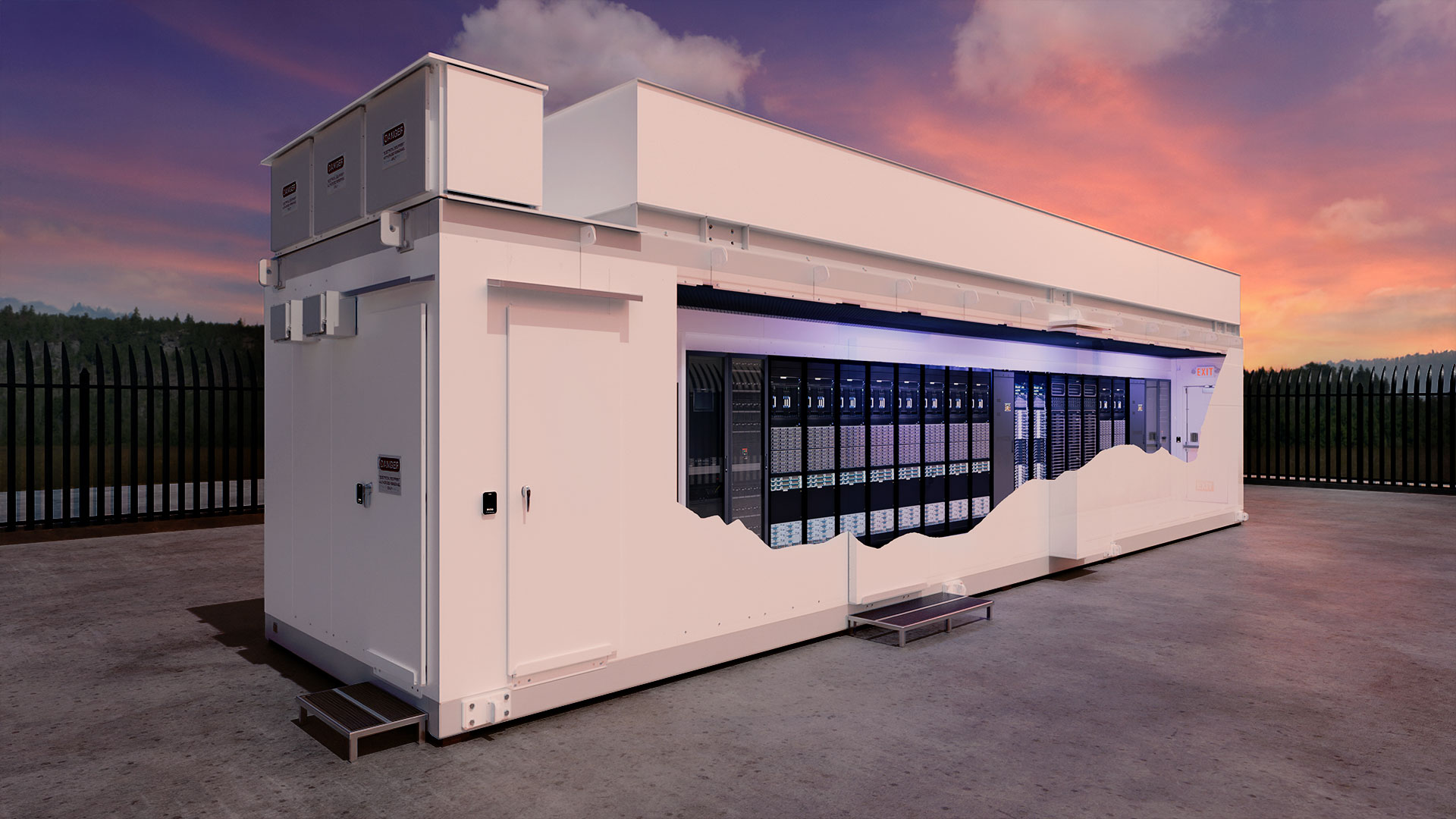
CDM’s Learning and Inference Modular Data Centers are engineered to help telecom operators bridge the gap between today’s 5G demands and tomorrow’s 6G requirements—placing scalable, high-density compute exactly where it’s needed, from the core to the edge.
- The L Series supports large-scale AI and HPC workloads in core or regional locations—processing massive datasets to optimize coverage, predict demand, manage network slicing, and improve quality of service.
- The I Series brings that intelligence to the edge, delivering low-latency, right-sized compute capacity at tower bases, metro hubs, and central offices—ideal for edge caching, network steering, and real-time analytics.
Together, they form a complete ecosystem for AI-enabled networks learning centrally, inferring locally, and scaling intelligently.
For remote or harsh environments, modular data centers can be constructed with ruggedized or ballistics resistant material built to withstand the challenges of next-generation telecom infrastructure.
Modular Data Centers in the Telecom Space
According to Grandview Research, the global 5G infrastructure market is projected to reach USD 95.88 billion by 2030, growing at a CAGR of 22.9%.
CDM’s modular data centers are prefabricated and factory-tested, then deployed on site in a fraction of the time of traditional builds offering scalability, efficiency, and rapid adaptability. As networks evolve to support AI-driven and latency-sensitive workloads, infrastructure agility becomes mission-critical. That is the beauty of modular in the telco space. Operators that can deploy a modular, AI-ready infrastructure the fastest will define the next phase of telecom leadership.
Key Takeaways
- 5G and 6G networks need more than bandwidth, they need intelligence.
- CDM’s Learning and Inference Modular Data Centers provide the compute foundation for AI-native connectivity—processing data centrally and acting instantly at the edge.
- Modularity means agility, delivering scalable, efficient infrastructure ready for both current 5G expansion and future 6G transformation.
The Road Ahead
As 5G networks evolve into AI-driven ecosystems and 6G pushes intelligence deeper into every connection, the ability to learn and infer across distributed environments will define the leaders of next-generation telecom. The future of connectivity depends on this balance of centralized learning and edge inference and CDM makes both possible.
