
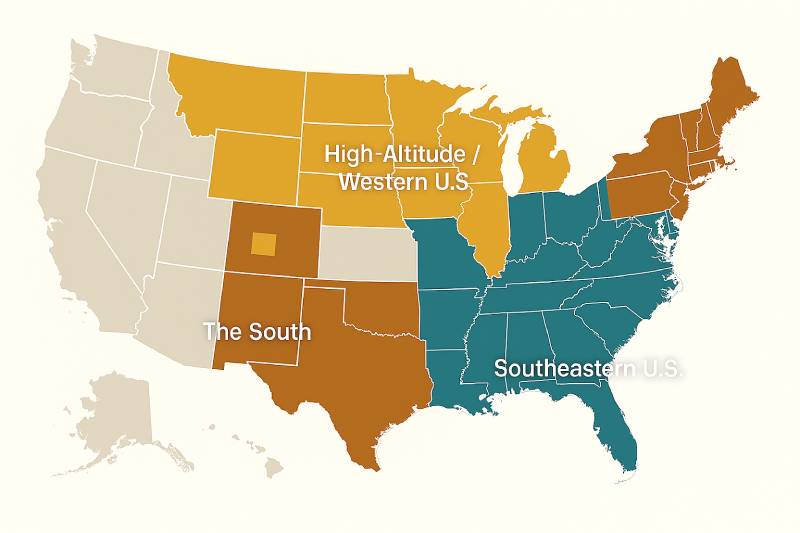
We’ve discussed the case for customized cooling solutions before, and it is still a hot topic (pun intended). As we move into August (2025), customers building data centers care about two things… How fast can a data center be up and running? And how efficiently can it run without wasting power and water? The answer to both lies in customized modular cooling solutions designed for region specific needs.
Below are examples of cooling strategies in the US based on geography, environment, and local infrastructure constraints.
Southeastern USA: A GPU-Intensive Data Hub
This region is emerging as a powerhouse for AI and HPC infrastructure, driven by low energy costs and investments in growing technology ecosystems. States like Virgina/WV and Florida, and cities like Atlanta, Raleigh, and Nashville are seeing demand for scalable, high-density deployments.
A modular data hub designed for GPU workloads utilized air-cooled units with hot aisle containment and high-efficiency CRAC systems, resulting in:
- PUE below 1.4
- 35kW per rack densities
- Rapid deployment timelines for AI-scale workloads
Northeastern USA: A Hotbed of Urban Edge Deployments
Putting massive data centers in highly populated cities like New York City, Boston, and Philadelphia, and states like Connecticut and Rhode Island face constraints on space, power, and permitting.
Modular data centers are perfect for dense edge locations where real estate is scarce and latency-sensitive workloads require proximity to populated areas. A custom hybrid cooling solution with closed-loop liquid cooling and air-side economization help minimize water usage, reduce noise levels, and deliver efficient cooling within tight footprints and strict permitting environments.
High-Altitude/Western USA: Leveraging Natural Conditions
Sites like Colorado, Utah, Nevada, and Wyoming (Western U.S.), have thin air with extreme temperature swings, which requires a different cooling approach.
A custom air-cooled system optimized for elevation with integrated economizers can use free cooling approximately 70% of the year, significantly reducing energy costs while maintaining performance at higher altitudes.
The South: Do You Like Your Heat Humid or Dry?
Thanks to the availability of land, supportive regulations and investment in the grid, Texas and Arizona are rapidly growing regions for hyperscale, AI and colocation deployments.
- Cities like Dallas, Austin, and San Antonio benefit from hybrid cooling systems that combine air and liquid cooling to support 30–40kW per rack loads. These designs reduce stress on the grid while ensuring consistent performance in hot climates.
- In areas like Phoenix and Tucson, custom direct-to-chip liquid cooling systems with closed-loop circulation can be used to eliminate reliance on evaporative cooling and reduce water usage key in this arid region.
At CDM, we design modular data centers that fit your environment and not the other way around. When data center cooling solutions are built to specific environments and workloads, you gain:
- Higher energy efficiency and lower PUE
- Faster deployment timelines with factory-integrated systems
- Reduced operating costs.
- Longer equipment life through optimized thermal management
